4 Mins

Written by: Conor Adamson
Corporate Finance Manager
Last reviewed: 12 October 2026Most fundraises start too close to when cash gets tight. By then, the founder has already lost the two things that matter most – time and leverage.
The phone rings in March. The founder did the math this past weekend. Cash runs out in August, or maybe September at most. They need to raise. Can we help? Of course we can help.
But the honest answer is that they have made the job much harder than it needed to be. Not because the business is bad. Usually, the business is good. They just started the wrong thing first and started it late. Raising money takes longer than you think it will. If you ask a first-time founder how long a raise takes, you will often hear “a couple of months.”
How Long Does It Take to Raise Investment or Debt?
If you ask a first-time founder how long a raise takes, you will often hear “a couple of months.”
However, from the first meeting to money in the bank, you are looking at four to nine months for a first institutional round. Sometimes even longer. That is not due to slowness by either party. It is due to the fact that there are multiple steps in the process, and each one has a waiting list. Finding the right investors takes time. Obtaining a term sheet takes time. Financial and legal due diligence takes four to eight weeks on its own, and that assumes all your paperwork is in order.
Therefore, if you want money by September, you should have been having meetings in January. And if you only have six months of runway when you begin your raise, you are simultaneously running a raise and a business with an immovable deadline.
What Happens If You Leave Fundraising Too Late?
This is where the cost lies in money or trust. When you need money, every word you speak is filtered through the knowledge that you need it. They know it. You know they know it. It alters the nature of the conversation in ways that are difficult to alter.
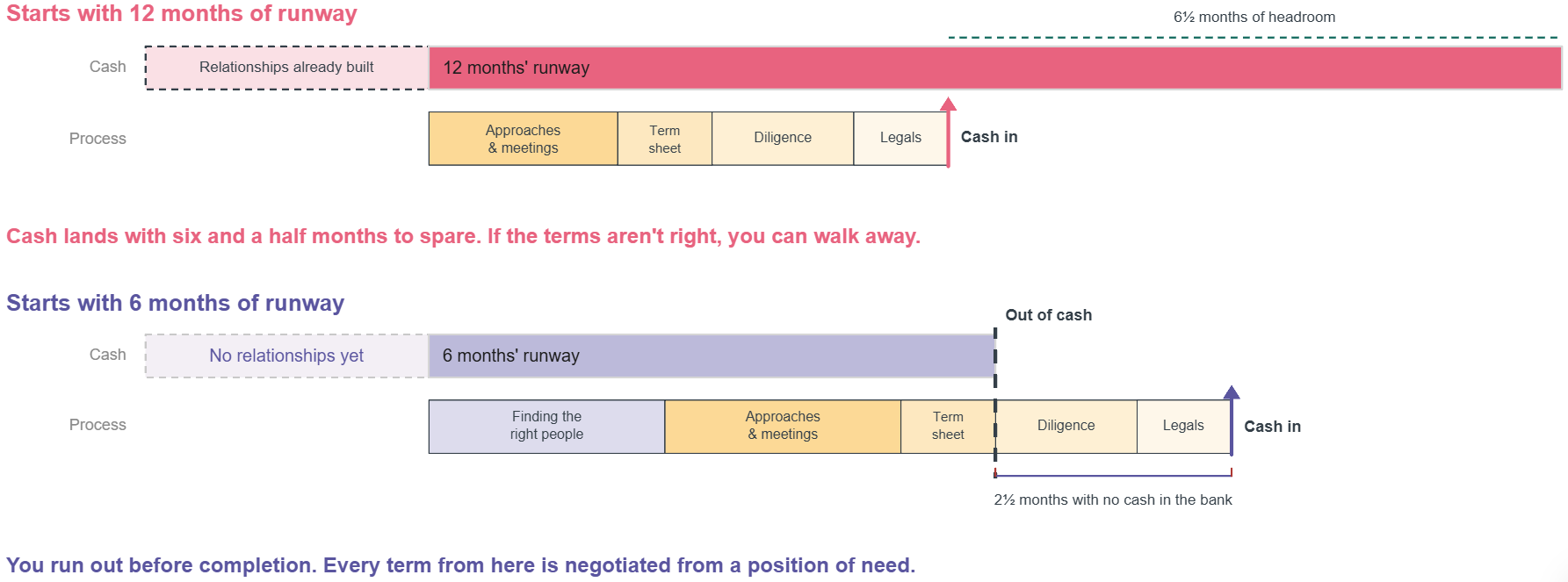
Your questions become worse. Instead of asking whether an investor is suitable for you, you start asking whether they will approve. You cease performing due diligence on them because you cannot afford to wait for the answer. You accept the first term sheet instead of the best one, and you bargain for items such as board composition, consent rights, and what will occur if the subsequent round of funding is flat from a position where rejecting the terms is not an option.
I have heard of founders signing contracts that they did not comprehend because their sole alternative was to pay payroll. These contracts do not expire. They remain in the contract for years.
Understanding the differences between debt finance and equity funding can also help founders decide which route is most appropriate for their circumstances.
How Should Founders Build Investor Relationships?
You would not email forty procurement managers on a Tuesday afternoon and anticipate a purchase order by Friday. You would determine who is the appropriate purchaser. You would attempt to obtain an introduction if possible. You would engage in dialogue prior to making a request. You would follow up when you stated you would follow up.
Nonetheless, this strategy is frequently abandoned when seeking to raise money. Honestly ask yourself: If you have engaged in a discussion with an investor or a lender in the past two years, did you follow up with them more than once? If this had been a warm lead – someone who had met with you for an hour – would you have abandoned the follow-up? Certainly not. You would have had a valid reason to contact them again within two weeks. This is especially true for first-time founders; however, few people inform them of this.
Second- and third-time founders obtain raises more easily because they are familiar with the individuals involved and, more importantly, those individuals trust them. You are establishing the business, the network, and the trust at the same time and from scratch. This is a significantly more arduous task than most believe, and it deserves recognition rather than denial. Fortunately, establishing a network can be achieved more quickly than anticipated.
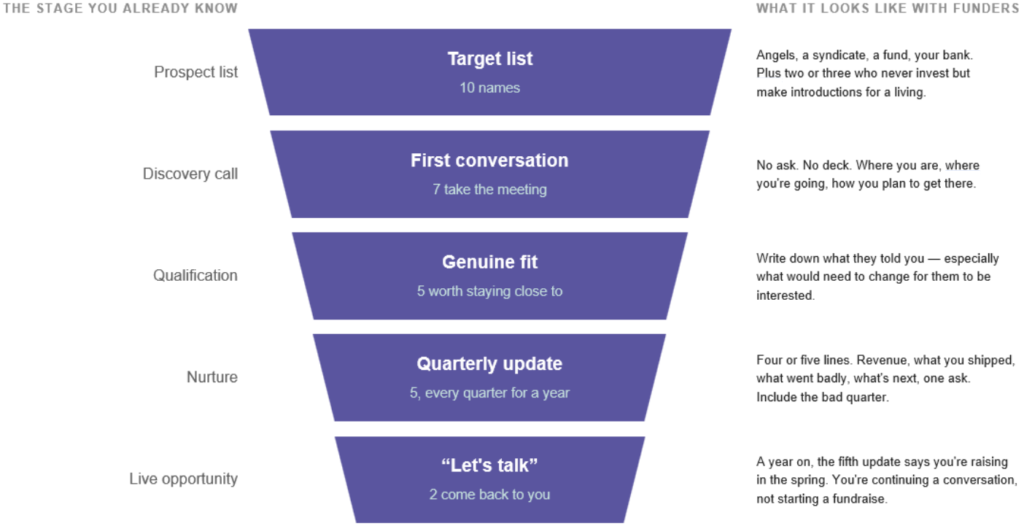
How Should You Manage an Investor Pipeline?
A CRM isn’t always necessary. A spreadsheet is fine. Your investor pipeline is the same as your sales pipeline.
What Should Founders Do When an Investor Says No?
This aspect of raising money is the most difficult for founders to understand and should not be.
You will receive similar responses: you are too early-stage. Your technology requires TRL 6; however, it is currently TRL 3. We require £500k ARR; however, you currently have £200k ARR. We do not invest in your industry at your current size.
This is not a “no.” This is someone telling you exactly what must occur for them to invest in you. Most founders view this as a door closing; however, it is more akin to a door with a sign on it.
Therefore, ask follow-up questions and ask them while you are present: What must occur for us to interest you, and when should I return? Then go out and do it. And when you reach £350k ARR, email them to let them know. You have just demonstrated two characteristics that no pitch deck can portray – that you listen and that you fulfil promises.
Key Takeaways
- A first institutional raise will realistically take four to nine months. Begin when you have twelve months of runway, not six.
- As the cash runway deadline approaches, you lose leverage on terms that extend beyond the current round of funding.
- Eight to ten names and a quarterly email is sufficient for your entire system. It costs an hour per quarter.
- A “no” accompanied by a reason is likely the most valuable feedback you will receive during the year. Ask what must change or whether they were suitable candidates in the first place.
Frequently Asked Questions
For many first-time founders, securing institutional investment can take between four and nine months from the initial investor conversations to funds being received. The process often includes investor meetings, negotiations, due diligence and legal documentation, all of which can take longer than expected.
A good rule of thumb is to begin fundraising when you still have around 12 months of cash runway remaining. Starting early gives you more time to identify suitable investors, build relationships and negotiate terms from a position of strength rather than necessity.
One of the most common mistakes is waiting until cash reserves are running low before starting the fundraising process. This can reduce negotiating leverage, limit available options and increase the pressure to accept terms that may not be the best long-term fit for the business.
Rather than treating a rejection as the end of the conversation, founders should seek to understand why the investor is not proceeding. Specific feedback on revenue levels, growth milestones or technology readiness can provide a roadmap for future fundraising discussions and help identify what needs to change before re-engaging.
Yes. Building relationships with potential investors before launching a fundraising round can help establish trust and familiarity over time. Regular updates on key milestones and business progress can make future fundraising conversations more productive and reduce the pressure associated with approaching investors for the first time when capital is urgently required.