6 Mins

Written by: Conor Adamson
Corporate Finance Manager
Last reviewed: 12 October 2026Founders spend months on the commercials, their deck and the model. However, the one thing that usually slows down a deal is the numbers.
At some point in most first rounds, there’s a moment that completely surprises founders.
Their pitch has gone well. There’s genuine interest. And then somebody requests their last twelve months’ management accounts, including a balance sheet, and a reconciliation to the year-end figures.
Long pause.
Because what exists is a Xero export, a spreadsheet the founder may maintain themselves, and a set of statutory accounts filed eight months after the year-end that nobody has looked at since.
Recent Client Example
During a recent fundraise, investor due diligence became primarily focused on the quality of the management information provided, rather than the growth story. The business was performing well, and there was no doubt about its commercial potential; however, we had to spend several weeks rebuilding portions of the financial picture because certain costs were not being properly recognised on an accrual basis and several items had been posted incorrectly in terms of timing.
There was nothing fundamentally wrong with the business; however, the investors could not gain sufficient confidence in the numbers until the necessary work had been completed. The raise eventually closed successfully; however, it required additional management time, advisory time and due diligence costs which could largely have been avoided if better financial reporting processes had been implemented from the beginning.
Why Are Financial Numbers More Important Than a Pitch Deck?
Your pitch deck will allow you to enter a room. Once you are in that room, the discussion will transition rapidly to determining whether anybody believes what you are telling them.
The method an investor utilises to test this is not by re-reading your slides. Rather, it is by assessing whether your business can generate accurate numbers consistently and timely without drama.
That is precisely what “investor ready” actually signifies.
Founders often focus on developing a compelling growth story, but successful fundraising also requires reliable financial information and preparation behind the scenes. Find out more about raising capital for a business.
How Do Investors Assess the Quality of Your Financial Information?
Improper accounting or cash accounting can distort your numbers, and this is by far the most prevalent gap I observe, and it merits being discussed briefly.
Cash accounting tells you what moved in and out of the bank account. Money in, money out, what’s left.
Accrual accounting tells you what you actually earned and what you actually owe, in the period it relates to, regardless of when the money moved.
For most early-stage businesses, both appear similar enough for founders to reasonably conclude it is an accounting nuance. Then the business model evolves slightly, and the discrepancy increases.
Consider a software business that invoices annually in advance. A client subscribes in January and pays £24,000 for the year. On a cash basis, January was an outstanding month. On an accrual basis, you generated £2,000 in January and are now holding onto £22,000 of deferred revenue = cash in your bank account belonging to a client who has yet to receive the service.
Founders operating on a cash basis experience two unwelcome surprises here:
First, their revenue growth is significantly less than they initially perceived.
Second, a substantial portion of the cash they had intended to use was never theirs. Similar problems occur in various forms. Businesses delivering projects recognising the full contract amount at invoicing rather than as they complete delivery. R&D tax credits appearing as revenue rather than below the line. Inventories that have never been accurately counted. A founder’s salary that does not appear on payroll. Prepayments and accruals nobody has posted previously. None of these are scandalous. They represent normal aspects of developing businesses.
However, every single one of them is uncovered during due diligence, and each one costs you time, credibility or value. Understanding how financial due diligence works can help founders identify and address these issues before investors begin their review.
What Do Good Management Accounts Look Like?
Investors don’t ask for these because they enjoy reading them. They ask because they tell you what kind of business you’re dealing with.
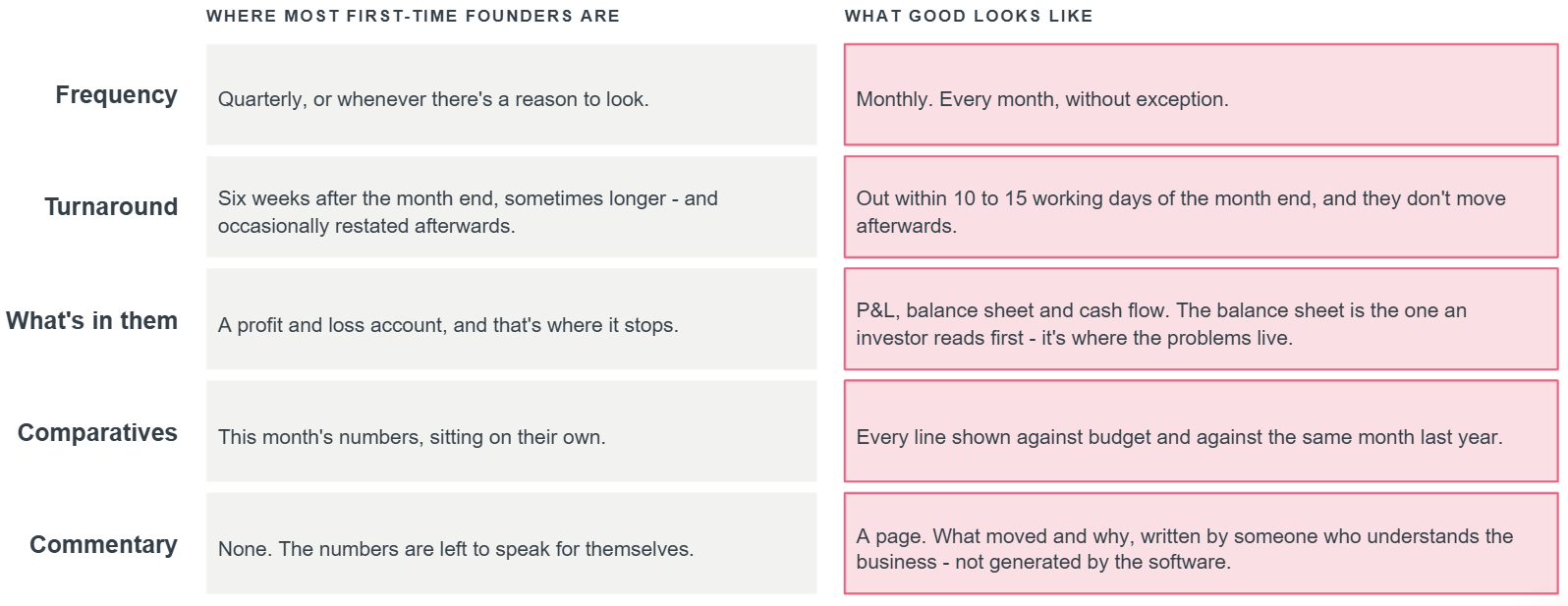
Management commentary is far more relevant than founders anticipate. A series of numbers accompanied by an explanation of the variation indicates “we know what is occurring here.” Conversely, a series of numbers alone indicates “here they are; determine it yourself.” For additional information regarding management accounts, you can read our article series here:
- Why Monthly Management Accounts Matter for SMEs
- Segmented Management Accounts Reveal Hidden Issues
- Management Accounts That Improve Valuation
Why Do Investors Care About Forecasts and Budgets?
The model presented in your fundraising materials is not a budget.
A budget represents a separate concept: the number you and your team have decided upon achieving during the current fiscal year, constructed from items you can individually control – headcount, pipeline conversion rate, pricing structure, retention rate – rather than from a top-down perspective based upon market size and percentage penetration.
Investors examine your model for the story. They evaluate your budget for your understanding of your own operating costs. Following the completion of the funding round, they will compare your budget to actuality every month.
I will revisit this issue in the subsequent article since this is where many first-time founders encounter difficulties.
Why Does Financial Reporting Matter So Much to Investors?
Because financial visibility serves as a proxy for management quality. No investor funds a business solely because its management accounts are excellent.
However, when those accounts are late, or require restatement, or when the balance sheet doesn’t reconcile appropriately, an investor starts asking a reasonable question: if this is the bit I can see, what’s the bit I can’t?
Practically speaking, poor quality financial information negatively affects a deal in three ways. It prolongs due diligence, which costs you additional time and expense. It provides the counterparty with justification for pricing risk associated with uncertainty, and likely not in your favour. Finally, in extreme instances it prevents completion of the transaction entirely – not due to deficiencies in the underlying business – but rather because nobody could develop sufficient comfort in the numbers quickly enough.
The frustrating aspect is that all of this is remediable and significantly less costly to rectify eighteen months prior to completion than three weeks prior to completion.
Key Takeaways
- Investors examine your deck once and your numbers every month for the next five years.
- If you bill in advance, or deliver over time, cash accounting is actively misleading you. Move to accruals before someone else points it out.
- Monthly management accounts, three statements, out within fifteen working days, with a page of commentary. That’s the bar.
- Late or unreliable numbers don’t usually kill a deal. They just make it slower and more expensive, which amounts to the same thing.
Frequently Asked Questions
Investor-ready means having the financial information, reporting processes and governance arrangements required to give investors confidence in your business. This goes beyond having a strong pitch deck and includes accurate management accounts, forecasts and robust financial controls.
Yes. Investors often review management accounts during due diligence to assess trading performance, understand trends and evaluate the reliability of financial reporting. Strong management information can help build confidence in both the business and its leadership team.
Cash accounting shows when money enters or leaves the bank account, but it may not accurately reflect when income is earned or costs are incurred. As businesses grow, this can create a misleading picture of financial performance and make investor due diligence more challenging.
Investors commonly request management accounts, budgets, forecasts, historical financial statements, cash flow information and supporting explanations for significant movements in performance. The exact requirements will vary depending on the size and stage of the business.
Preparation typically involves improving financial reporting processes, ensuring records are accurate and up to date, reconciling key balances and maintaining clear documentation. Addressing issues before entering a fundraising process is usually easier and less costly than fixing them during due diligence.