6 Mins

Written by: Conor Adamson
Corporate Finance Manager
Last reviewed: 12 October 2026The photo with the cheque is the starting point, but what does the first Monday after the deal look like?
All founders have seen it. The announcement. The team photo. The “we’re delighted to tell you about our £2 million round.” No one publishes the one six weeks later, when it’s the 8th of the month, the management accounts aren’t complete, and the board pack is due on Friday. This isn’t a complaint about investors. For the right business at the right time, institutional capital is definitely the right move and I spend a large part of my time helping founders get to that position.
However, I believe we do first-time founders a disservice by focusing so much on how to obtain funding and so little on what having funding is like. The best way I’ve found to put this into perspective is as follows: You haven’t simply obtained capital. You’ve obtained a new member of the company. Not an employee. Someone closer to a major new shareholder-cum-customer-cum-colleague who has opinions, rights and a long memory. As with all new members of the company, much of the relationship is based upon communication.
What Changes When Investors Join the Board?
If your round included an institutional investor, you will likely have a board and possibly an investor director or observer. What surprises founders is not the meeting but rather its timing. Board papers are issued in advance (generally five business days) and that deadline is non-negotiable.
Therefore, your monthly financial reports must be completed by approximately the 10th each month regardless of what other fires are burning. Founders that have already invested in robust financial reporting processes often find this transition significantly easier. Read more about What Does Investor Ready Really Mean?. Many companies find that this is the most significant operational change that occurs as a result of a round, and it is also one of the changes that most founders least anticipate. Board meetings typically last two to three hours.
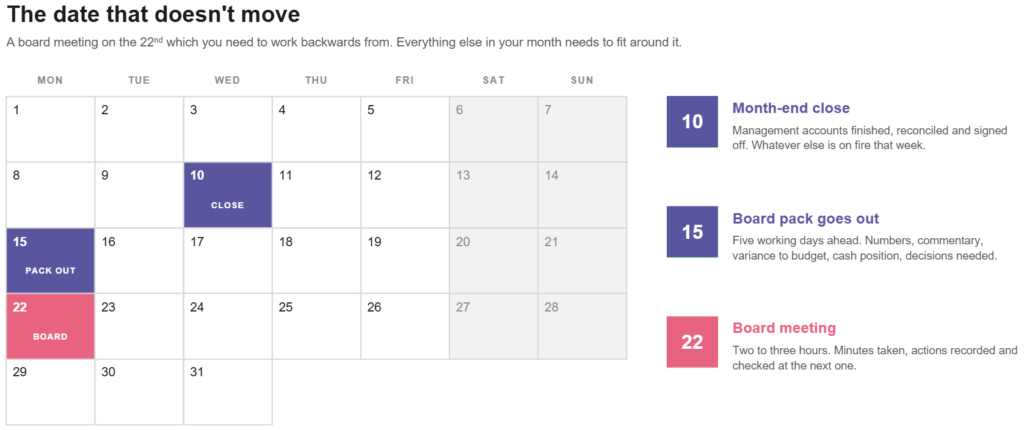
A suitable board pack consists of management accounts with commentary, performance relative to budget, cash position and forecasts, key performance indicators (KPIs), an update on those items that were previously committed to by you and any matters that require a decision. Minutes are taken, action items are documented and reviewed at subsequent meetings.
If done correctly, it can provide genuine value – one hour of senior-level attention on your business that you would likely struggle to purchase elsewhere. If done poorly, it can represent a monthly test.
Do You Need Additional Finance Support After Raising Investment?
Closing out a month to meet the standards of a board-ready report is significant work. Most companies transitioning from their first institutional round will require three to five days of finance staff time per month – every month. If that work currently lives with the founder and a bookkeeper, it will not survive contact with a board timetable. Something gives, and usually what gives is the founder’s evenings.
This is why a first round is so often followed by a finance hire – a financial controller, a part-time FD, or an outsourced function that can close the month properly. It is worth thinking about before completion rather than after, because the cost of it should be in the plan you’re presenting.
Which Business Decisions Require Investor Approval?
Your shareholders’ agreement will contain a list of actions that cannot be taken by the company without prior approval from your investors. Reserved matters; consent matters; whatever terminology your lawyers choose to use.
These matters vary but generally can be split as below.
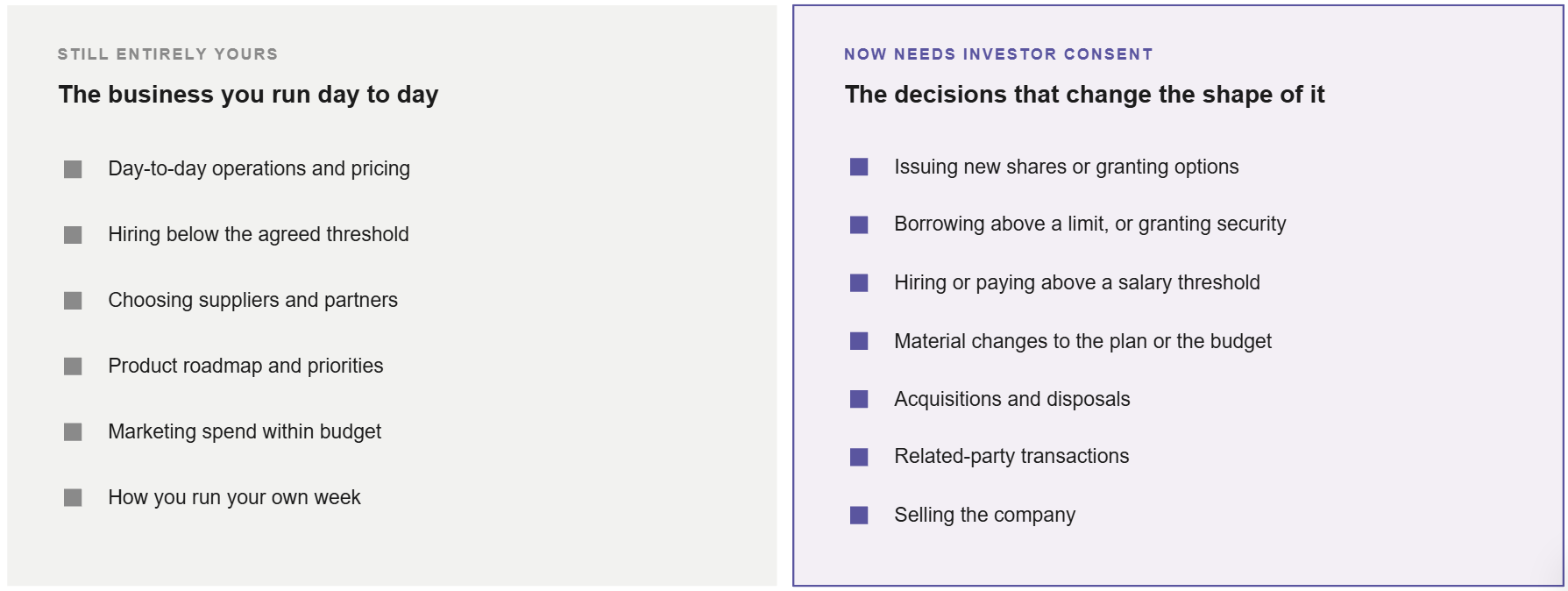
All of these are not indications of an investor being unreasonable. They represent provisions within the agreement that you signed. And that is the ultimate point: read it carefully prior to signing; ensure that your senior team members understand its contents after signing. The most preventable friction that I observe after completion arises from a founder taking an action that appears perfectly reasonable and commercially sound without realising that it required prior approval from their investors.
How Often Should You Report and Forecast After Fundraising?
There are essentially three types of forecasting cadences:
- An annual budget that is approved by the board before the start of each fiscal year. The annual budget serves as a baseline for measuring success throughout the year.
- Quarterly reforecasts are conducted on a regular basis. Quarterly reforecasts assist in preventing failures from becoming crises.
- A rolling thirteen-week cash forecast is maintained on either a weekly or bi-weekly basis if cash flow is problematic; otherwise, it is updated on a monthly basis. If there is one report that helps founders avoid trouble, it is this report.
Regular forecasting reviews can also help manage investor expectations and reduce the risk of unexpected performance discussions at board meetings. Read our full article on The Fundraising Mistake That Damages Investor Trust.
What Is It Like Working With Investors After a Fundraise?
Honestly? It feels more organised; more accountable; more apparent. You will likely spend approximately three to five days per month preparing reports for your board and communicating with your investors – tasks that you did not perform previously. You will likely make decisions at a slower pace than you were accustomed to doing. You will likely have to provide explanations for your actions more frequently than you were accustomed to doing.
Many founders find that they prefer this structure – the rhythm requires clarity; having experienced professionals inquire into your business on a monthly basis is worth more than most consulting engagements. Some founders find that they do not prefer this structure. Both responses are valid; the time to determine which type of founder you are is way at the beginning of the process; not eighteen months after signing.
How Does Investor Reporting Support a Future Exit?
Everything included in this article – reliable monthly financials; a forecast you meet; a documented decision-making process; a team capable of operating independently of you during meetings – is precisely what buyers examine when they ultimately evaluate your business for acquisition. Many of these same disciplines can also support future financial due diligence exercises when raising further investment or preparing for a sale.
So, do not create this infrastructure for one day each month and allow it to dissipate in between; create it – then preserve it. Somewhere along the road, a new individual will arrive who was not present for any of this – and they will seek verification regarding the journey your business has experienced. Each month you preserve represents a month they do not have to accept on faith – and what a buyer does not have to accept on faith, they do not devalue.
Key Takeaways
- Board papers five working days ahead means numbers finished by the 10th. Every month. That’s the real change.
- Budget for finance resources required to produce those reports prior to completion rather than after completion.
- Understand your reserved matters – and ensure that your team understands them as well.
- The reporting discipline you establish today will be the same one that enables you to sell your business later – maintain those records.
Frequently Asked Questions
After raising investment, businesses are often required to provide more regular financial information, attend board meetings and maintain ongoing communication with investors. Founders may also need to obtain approval for certain strategic or financial decisions depending on the terms of the investment agreement.
Reporting requirements vary, but many investors expect monthly management accounts, cash flow information, performance against budget and updates on key business objectives. Board papers are often circulated several days before scheduled board meetings.
Not necessarily. Founders usually remain responsible for running the business, but investors may receive certain rights relating to major decisions. These rights are typically documented within shareholder agreements and investment documentation.
Many growing businesses benefit from additional finance support following investment. This might involve a financial controller, part-time finance director or outsourced finance function to help meet reporting requirements and support decision-making.
Good governance helps ensure investors receive accurate information, important decisions are properly documented and risks are identified early. It can also help businesses prepare for future fundraising, due diligence processes and eventual exit opportunities.