6 Mins

Written by: Conor Adamson
Corporate Finance Manager
Last reviewed: 12 October 2026You get valued on your forecast once. For the next five years, you will be judged every month on your forecast.
The founder is frustrated. The business is growing. Revenue is up significantly from last year. Customers are happy. Yet, every Board meeting seems like an interrogation. The relationship with the investor is dead. And there is a real feeling that something is very wrong.
It’s not the business. The business is doing well. The issue is that eighteen months ago, in the frenzy of raising capital, numbers were placed into a spreadsheet that could never be met. Building reliable forecasts starts with having accurate management information and a clear understanding of business performance.
Recent Client Example
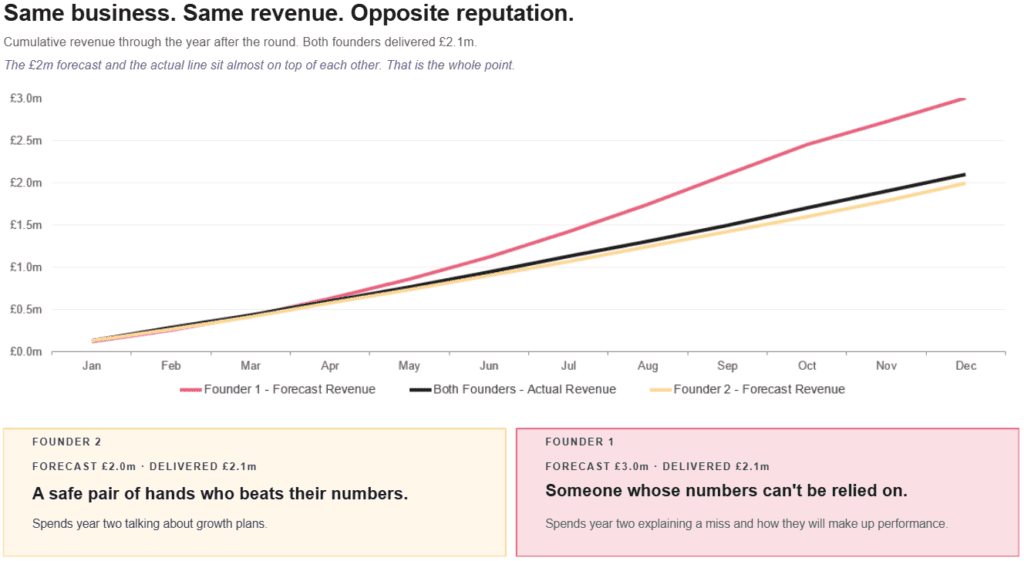
We worked with two businesses that raised capital within approximately the same time frame. Ultimately, both generated roughly the same amount of revenue performance. One management team had conservatively and modestly forecasted their performance. The second had presented a much more aggressive forecast and failed to achieve it.
The first management team spent Board meetings discussing potential growth opportunities and strategic alternatives. The second management team spent Board meetings explaining why they failed to meet their forecasts and attempting to re-establish investor confidence in the numbers. Performance was not the differentiator between these two businesses. Expectations were.
Why Do Founders Over-Forecast Revenue?
Generally for legitimate reasons. A portion of it is true optimism; optimism is a characteristic, not a flaw – you cannot begin a business expecting everything to go poorly. A portion of it is that founders believe investors desire to see large numbers and that a moderate forecast signals a moderate founder. Additionally, valuation discussions are based upon forecasts; therefore, a larger forecast appears as if it provides actual financial benefit. That last point is accurate for a brief period.
That last point can be accurate; however, it is also a trap.
You are valued on your forecast once, but you are measured against that forecast every month, at every board meeting, for the duration of the investment. The quality of the financial reporting that supports those forecasts can be just as important as the forecasts themselves. Read our article on What Does Investor Ready Really Mean?.
That is a poor bargain, and almost no one evaluates this equation at the time. Adding twenty percent to your year-two revenue line may provide you with a slightly higher valuation today. However, it will also ensure that your second year is devoted to explaining a miss, in a room where your credibility is the sole form of currency available to you.
Here are two businesses with identical performance. One forecast £2 million and achieved £2.1 million. The other forecast £3 million and achieved £2.1 million. The first founder is a safe pair of hands who consistently exceeds their numbers. The second founder is a person whose numbers cannot be trusted. Both achieved the same level of revenue. However, their reputations differ greatly, as does their ability to obtain support for subsequent rounds of funding.
What Happens When Investors Are Surprised by Performance?
Investors do not expect you to hit your forecast every quarter. Investors have experienced this process previously. Investors recognise that a plan is a plan but they cannot tolerate being informed after the fact. There is a world of difference between these two types of Board meetings:
Meeting A. Q3 is 20% below budget. The founder flagged it in week four of the quarter when the pipeline told them it was coming, explained why, set out what they were doing about it, and came to the board with a revised number.
Meeting B. Q3 is 20% below budget. The board found out when the pack arrived, three weeks after quarter end.
Same performance. In the first, the founder is running the business. In the second, the board is wondering what else they haven’t been told, and someone starts asking for weekly cash reporting.
It is not missing targets that destroys the relationship between an investor and a founder. It is surprising people.
When Should Founders Reforecast Their Numbers?
When a quarter begins to go wrong, people’s instinct may be to refrain from communicating this fact and attempt to rectify the situation. Occasionally, founders succeed in rectifying the situation, and no one is aware that it occurred. However, this is a risky strategy because the negative consequences associated with failure are significant while the positive consequences associated with success are limited to avoiding a single uncomfortable email.
The better approach involves a rolling reforecast. Periodically review your numbers on a quarterly basis as part of your normal operating procedures so that revising your forecast does not represent an acknowledgement of failure; rather, it represents another day. When your picture changes significantly, inform those involved in days – not at your next scheduled meeting.
A high-quality “we’re going to miss” memo is brief and contains four components:
- Here’s the number, and here’s what we now expect.
- Here’s why – specifically, not “market conditions.”
- Here’s what we’re doing about it, and by when.
- Here’s what I’d like from you, if anything.
This email requires fifteen minutes and represents a greater value to your relationship with your investors than a positive quarter. Any individual can report a positive quarter.
How Should Founders Communicate With Investors?
Founders who emerge from their initial institutional round with strong relationships with their investors are virtually always founders whose investors were continuously aware of where they stood relative to expectations.
If you advise someone that a quarter will be weak and why, and what you intend to do – and if your subsequent update demonstrates that you followed through – you have demonstrated two characteristics simultaneously. You demonstrated that you possess the ability to identify problems and that you communicate honestly regarding your own business. There is no slide that demonstrates these characteristics; moreover, you cannot fraudulently demonstrate these characteristics retrospectively. These characteristics develop one quarter at a time.
How Can Founders Set Realistic Investor Expectations?
Practical methods for preventing establishment of the trap in the first instance include:
- Forecast your best-case scenario and describe potential upside separately. Investors are able to retain two numbers in their minds. “Here is our plan, and here is what happens if these two variables come together” is a more powerful statement than one inflated line.
- Construct your forecast from drivers that you control. Drivers include headcount, conversion rates, prices, and churn rates. If your growth assumption cannot be traced back to an activity that you can directly execute, then it is merely an assumption.
- Evaluate the shape of your forecast. If year two requires you to increase your sales force threefold, inquire as to who will recruit them, how long will it take for them to become productive, and if the associated costs are included in your model.
- Document your assumptions. Not for your investors – but for yourself. In eighteen months you will desire to recall what assumptions you actually believed and why.
Key Takeaways
- The forecast that yields a higher valuation is the forecast that will be utilised as a basis for evaluation for five years. Consider this fact.
- Forecast something that you can surpass. Surpassing a reasonable number builds greater credibility than failing to achieve an ambitious number.
- Investors can tolerate missing targets. Investors cannot tolerate learning about missing targets late.
- Continually re-forecast quarterly as part of your routine operations so that revising your forecast ceases to be an event.
Frequently Asked Questions
Investors generally understand that forecasts will not be perfectly accurate. What matters most is that assumptions are reasonable, supported by evidence and updated as circumstances change. Consistent delivery against realistic expectations usually builds more confidence than missing overly ambitious targets.
No. Most investors recognise that business performance can vary from plan. However, they expect management teams to monitor performance closely, identify issues early and communicate openly when results are likely to differ from expectations.
Over-forecasting can create expectations that are difficult to achieve. Even if a business performs well, consistently missing projected numbers may reduce investor confidence and lead to increased scrutiny of future plans and forecasts.
Many growing businesses benefit from regularly reviewing and updating forecasts throughout the year. A rolling forecasting approach can help management teams identify changes early and communicate any significant variances before they become larger issues.
The most effective approach is usually to communicate early, explain the reasons clearly, outline corrective actions and provide updated expectations. Investors are typically more concerned about unexpected surprises than about short-term performance challenges themselves.