5 Mins

Written by: Conor Adamson
Corporate Finance Manager
Last reviewed: 12 October 2026Most deals do not fall apart based upon valuation. Rather, they fall apart (or get re-priced) due to the items in the balance sheet that no one took the time to sort out.
There is a category of problems that only appear at the worst possible time. It’s not a bad business. It’s not a bad market. It is simply a series of small, completely normal loose ends that were not addressed by anyone because there was always something more important, and which are now appearing one by one, courtesy of another party’s financial due diligence advisor or lawyer, four weeks prior to closing when there is no longer any opportunity to negotiate.
While none of these issues are particularly challenging to resolve, it is significantly less expensive to resolve them early. Early preparation can often make fundraising discussions more efficient and reduce avoidable delays later in the process.
Recent Client Example
We were involved in raising growth capital for a company. The initial meetings focused on the growth opportunity, valuation, and future plans for the business. When financial due diligence started, however, the focus quickly shifted to a number of balance sheet items that had not received nearly as much attention internally. These included shareholder funding, historical balances between group entities, and facilities that had grown over time.
None of these items represented anything particularly unusual, nor did any represent a deal-breaker. However, they did require discussions among shareholders, advisors, and potential investors that could have taken place several months earlier. The main practical consequence was not that the deal failed. Rather, management spent significant amounts of time resolving historical issues at the precise moment they were attempting to finalise a transaction.
The lesson learned was not that the business had done anything wrong. Instead, it was that conversations regarding these types of issues are almost always simpler prior to commencing a funding process than once it has commenced.
How Can Director and Shareholder Loan Accounts Affect a Fundraise?
This is one of the more common issues. Directors’ loan accounts exist in both directions. If you owe the company money (an overdrawn director’s loan account), you may face several consequences.
If you owe the Company money – For example, if you do not pay off the outstanding balance within nine months and one day following the year-end, the company may be subject to a corporate tax assessment.
If the company owes you money (you personally funded the business), that is a completely normal item to appear on the company’s balance sheet. However, a prospective investor will want to know what will happen to that amount.
Specifically, you will likely be asked one of three questions: will it be repaid at completion; will it be subordinated behind their money; or will it be converted into equity? The answer to these questions is commercially significant.
For example, if you elect to repay the outstanding balance at completion, then a significant portion of the investment will be returned immediately to you. That reduces the total amount of money available to the business. So, it is preferable to proactively discuss and agree upon how that amount will be treated prior to being surprised by that question.
What Existing Debt Arrangements Should You Review Before Raising Investment?
Pull your facility letters out and read them over. Specifically:
- Are your overdrafts repayable on demand? Investors typically dislike the notion that a substantial portion of your working capital can be drawn down at a mere fortnight’s notice.
- What collateral supports your debt? Common forms of collateral include debentures over company assets; fixed charges; and cross-guarantees between group companies.
- Do you have personal guarantees? Personal guarantees are very common in early-stage lending and represent a key area for negotiation. Investors may be uncomfortable with founders having their homes at risk, as that risk could influence decision-making adversely. Negotiating or releasing personal guarantees requires time and involves a third party.
- Do you have change of control clauses? An equity investment may trigger these clauses. It is advisable to be aware of them prior to seeking approvals that no one has requested yet.
Alternatively, a new investor may require you to repay your existing debt prior to completion so this may have an impact on your near-term cash flow.
Should Debt Be Converted Into Equity Before a Funding Round?
Converting debt to equity is a common cleanup activity performed prior to completing a deal. Converting debt to equity cleans up your company’s balance sheet; increases the appearance of your company’s net asset position; and eliminates a potential topic for discussion during negotiation.
Two points to note:
- First, converting debt to equity results in tax implications for both the company and the lender. Tax implications vary depending on amount, relationship, and timing. This is an area where you should seek professional advice before proceeding.
- Second, converting debt to equity alters your company’s cap table. Therefore, consider converting debt to equity in conjunction with your funding round rather than as an independent action. You don’t want to realise you’ve negatively diluted yourself in a manner that negatively impacts your ability to raise additional funds.
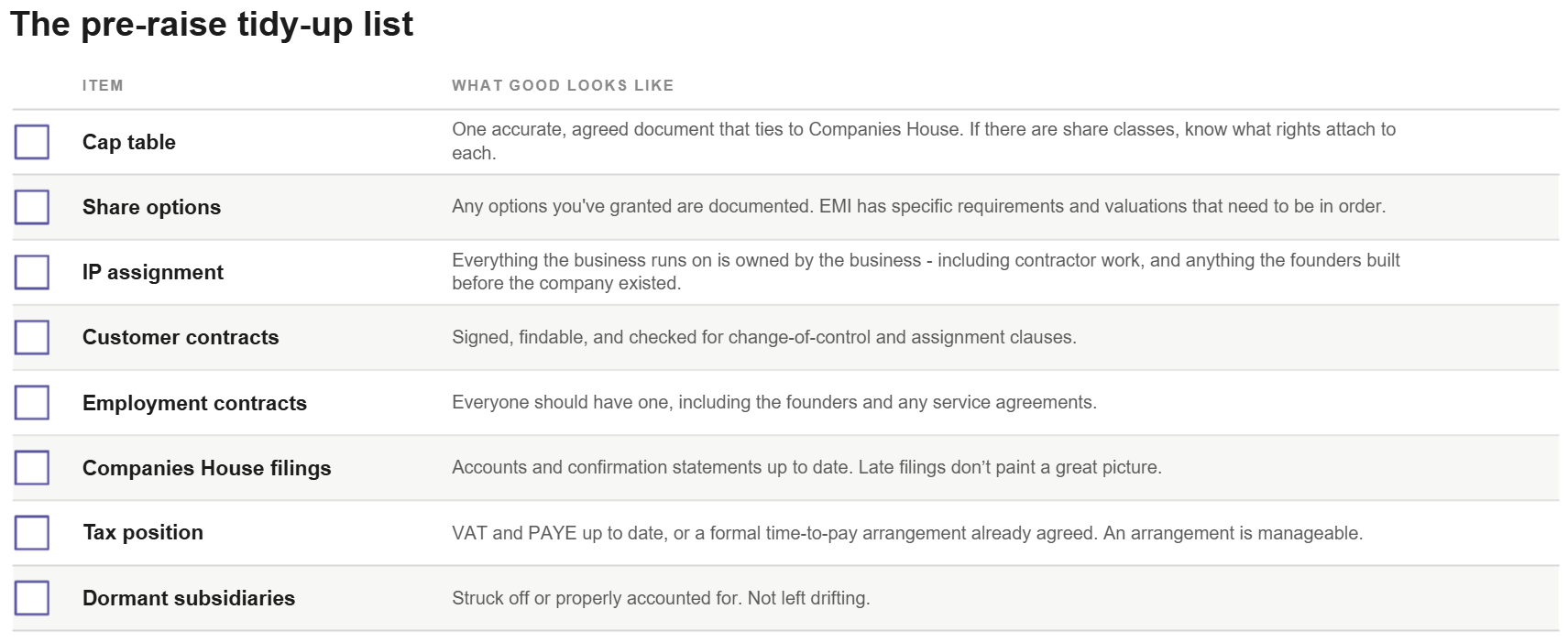
What Else Should Be Reviewed Before Investor Due Diligence?
Why Is Early Disclosure So Important During Due Diligence?
The single most important thing in this article.
Almost none of the items above will kill a deal or create complications down the line. Businesses are messy, and investors know it. What causes deals to fall through is when an investor discovers something you failed to disclose.
When an investor discovers something you failed to disclose, two events occur: they start questioning what other undisclosed items exist within your business, which expands and slows down their due diligence efforts; and your credibility suffers at precisely the time you require it most.
Disclose early.
Key Takeaways
- Prior to contacting potential funders regarding raising capital for your business, clear or document your Directors’ Loan Account.
- Review your letters of facility and determine what collateral supports your debt. Personal Guarantees require time to release/unwind.
- Informal family/shareholder funding is the most common headache experienced during late-stage due diligence efforts. Document it now.
- Regardless of what you uncover during your due diligence efforts, disclose it yourself. Problems are rarely associated with the existence of an issue; rather, problems are associated with the discovery of an issue.
Frequently Asked Questions
A director’s loan account records money owed either by the company to a director or by a director to the company. These balances are common in growing businesses but can attract additional scrutiny during fundraising and due diligence processes.
Yes. Investors will often want to understand the nature of the balance, how it arose and how it will be resolved. Unclear arrangements can create additional questions during due diligence and potentially slow a transaction.
Investors want to understand how existing borrowing may affect the business after investment. This can include reviewing repayment terms, security arrangements, personal guarantees and any clauses that could be triggered by an investment transaction.
There is no single answer. Some shareholder loans are repaid, while others are subordinated or converted into equity. The most appropriate solution will depend on the circumstances of the business, the investment structure and shareholder objectives.
Delays often occur when investors discover issues that have not been identified or discussed earlier in the process. In many cases, the issue itself is less important than the time required to investigate it and agree how it will be addressed.